

Managing Partner
When parties enter into agreements, they often do so believing that the contract is clear and unambiguous, and that both parties will carry out the agreement in the way that they have in mind.
All too often, however, parties to these agreements will find themselves in legal disputes, with one or more parties claiming that the contract was “breached.”
This reality underscores the critical importance of understanding not just contract terms, but also the legal framework surrounding contract disputes—particularly the statute of limitations for breach of contract claims.
For New York business owners, understanding these nuances isn’t just a legal formality—it’s a critical strategy for protecting your company’s financial and operational interests.
Contract disputes don’t always follow a clear path. Whether triggered by shifting business relationships, alleged breaches, or governance breakdowns, these conflicts often demand experienced litigation counsel capable of resolving them with precision and force.
Woods Lonergan PLLC’s contract litigators have a 30-year record of success in New York’s state and federal courts, including the Commercial Division. We represent business owners, investors, and C‑level executives in multi-million-dollar disputes involving complex contracts, strategic partnerships, and commercial obligations.
To speak with one of our New York contract lawyers, call 212-684-2500 or book a confidential consultation online.
Understanding the statute of limitations for breach of contract claims is crucial, considering that disputes are not always straightforward. While some contractual disagreements can be pinpointed to specific time frames and terms, it’s more common for disputes to arise from:
- Long-standing business relationships where terms have informally evolved over time
- Unanticipated events with adverse impacts hidden in the fine print of contracts
- Complex scenarios involving multiple parties across various jurisdictions.
This guide provides New York business owners, shareholders, and advisors with a clear understanding of their contractual rights, obligations, and legal deadline to file a contract lawsuit under New York’s complex breach of contract laws
Key Points
- Six-year statute for most contracts: In New York, most non–goods breach of contract claims must be filed within six years under CPLR § 213(2), measured from the date of the breach.
- Shorter deadline for sale of goods: Contracts involving the sale of goods are governed by UCC § 2-725, which generally imposes a four-year statute of limitations.
- Clock starts at breach, not discovery: The statute of limitations usually begins to run when the breach occurs, even if the injured party only discovers the problem later.
- Limited and narrow exceptions: Doctrines such as the continuing wrong doctrine, equitable tolling, or contractual extensions may apply in rare cases, but courts interpret these very narrowly, so businesses should not rely on them.
Elements of a Breach of Contract Claim in New York
Generally, a breach of contract occurs when a party fails to perform its obligations as defined by the terms of an agreement. Under New York law, a contract is considered breached when the following elements are present:
The Three Essential Elements of a Breach of Contract Claim in New York:
- The existence of a valid contract: There must be a legally binding agreement between the parties.
- Breach by the defendant: The defendant failed to perform their obligations as defined by the contract.
- Damages to the plaintiff: The plaintiff suffered some form of harm (usually financial) due to the defendant’s breach.
A contract is a legally binding agreement in which the parties exchange something of value. The parties entering into the contract agree to abide by its stated terms. When a party fails to fulfill its obligations under the agreement, it is considered a “breach” of contract, opening the door to legal remedies.
Breaches can manifest differently across various industries, sectors, and contexts. For example, a breach in a real estate transaction will look different from a breach in a technology licensing agreement or a supply chain contract. Despite these variations, breaches generally occur in the following ways:
- Failure to deliver goods or perform services: This occurs when a supplier fails to deliver promised goods, or a service provider does not perform the agreed-upon services. For example: a marketing agency fails to produce the promised advertising campaign for a Brooklyn retailer’s crucial holiday season, resulting in lost sales opportunities.
- Non-payment for goods or services: This happens when a client neglects to pay for goods received or services rendered. For example: a Queens construction company completes a project for a real estate developer but does not receive payment, impacting their cash flow and ability to take on new projects.
- Violation of contract terms: This encompasses any action that deviates from the explicitly stated terms and conditions of the contract. For example: a commercial real estate developer uses lower-quality materials than specified in the contract with a NYC property management company, potentially affecting the building’s long-term value and safety.
These are just a few examples, and the specific circumstances of each breach will determine the appropriate legal course of action.
Remedies for a breach of contract primarily involve monetary damages. These damages aim to make the non-breaching party “whole” by compensating them for financial losses directly resulting from the breach. In some situations, damages might also cover less tangible harms, such as reputational damage, or, rarely in business settings, emotional distress.
However, if you suspect fraudulent activity alongside a contract breach, it is crucial to understand that fraud is a distinct legal claim with its own standards and potentially different statutes of limitations.
Complex cases involving potential fraud may necessitate additional legal considerations beyond standard breach of contract claims. The interplay between fraud and contract law can significantly influence legal strategies and timelines.
With over 30 years of experience, Woods Lonergan PLLC’s trial attorneys have a proven track record in New York’s state and federal trial and appellate courts, including the Commercial Division of the New York Supreme Court.
We are known for successfully representing individuals, small businesses, and mid-sized companies in high-stakes litigation, often involving multi-million dollar claims, against major corporations represented by prominent law firms.
Our New York Contract Lawyers have secured significant verdicts and settlements for our clients by skillfully navigating all available avenues of dispute resolution. To speak with one of our attorneys about your specific situation, contact Woods Lonergan PLLC at (212) 684-2500 or Book a Call online today to explore your legal options.
Understanding NY’s Breach of Contract Statute of Limitations: CPLR vs. UCC for Goods
In New York, breach of contract claims have a six-year statute of limitations under CPLR 213(2), but contracts for the sale of goods follow a different rule under the UCC. Under UCC § 2-725, the statute of limitations for such breaches is shortened to four years.
CPLR or UCC: Which Applies to Your Contract?
Determining whether the CPLR or the UCC applies is critical for establishing the correct statute of limitations in a New York breach of contract case. This distinction directly affects the timeframe within which a business owner can pursue legal action.
When Does the Statute of Limitations Clock Start in New York?
Crucially, the clock starts ticking on the statute of limitations from the date the breach occurs, not from when it’s discovered. This holds even if the breach isn’t immediately apparent. Consequently, you have precisely six years (or four years for contracts governed by the UCC) from the moment of the breach to initiate legal action, irrespective of your awareness of the violation. This principle applies equally to written and oral contracts, underscoring the importance of promptly addressing suspected breaches.
Breach of Contract: The Risks of Missing the Filing Deadline
Failing to file a claim within the statutory window (six years for general contracts, four years for the sale of goods) can permanently bar you from pursuing legal recourse and recovering damages, even with a valid claim. As illustrated in cases like Statharos v. Statharos (2nd Dept.), the “timer” on breach of contract claims begins when the breach occurs, regardless of the non-breaching party’s awareness. This is in accordance with Section 213(2) of the New York Civil Practice Law & Rules (CPLR), unless the contract involves the sale of goods, which is governed by UCC § 2-725.
The New York Courts and the Priority of Commercial Repose in Contract Disputes
This strict deadline underscores New York courts’ commitment to providing businesses with “commercial repose”—a principle that ensures predictability and finality in contractual relationships. “Commercial repose” acknowledges that businesses need a definitive endpoint to their potential liabilities for past actions.
By setting a clear time limit for bringing claims, businesses can better manage long-term contractual relationships and plan strategically without the looming threat of indefinite legal exposure. This emphasizes the importance of regularly monitoring your business operations and agreements, promptly addressing potential breaches, and knowing which statute of limitations applies to your specific contracts
Woods Lonergan PLLC’s contract litigators have a 30-year record of success in New York’s state and federal courts, including the Commercial Division. We represent business owners, investors, and C‑level executives in multi-million-dollar disputes involving complex contracts, strategic partnerships, and commercial obligations.
To speak with one of our New York contract lawyers, call 212-684-2500 or book a confidential consultation online.
When Does the Breach of Contract Clock Start? New York’s Approach
Determining the precise start date of the statute of limitations is a critical legal calculation that directly impacts your ability to recover damages. In New York breach of contract cases, the clock begins ticking from the date the breach occurs, not from when the breach is discovered. This distinction is crucial because it dictates whether you can seek legal remedies or forfeit your right to pursue them.
Contract breaches are rarely uniform. Some are immediately obvious violations, while others develop gradually, with their full impact not apparent until considerable time has passed. These variations underscore a fundamental legal principle in New York: the moment of breach, not its discovery, triggers the statute of limitations.
Consider these scenarios illustrating how this principle applies in different industries and business contexts:
1. Brooklyn Tech Startup: Missed Lawsuit Deadline Consequences:
A tech startup contracts with a development firm to create a critical customer-facing application, with a strict delivery deadline of January 1, 2025. When the firm fails to deliver the complete, functional platform, the startup’s entire go-to-market strategy is compromised. Despite not discovering the full extent of the breach until February 1, the legal clock began ticking on January 1 – the original contractual deadline.
2. Tribeca Property: Neglected Maintenance:
A commercial property owner leases space to a tenant responsible for maintaining the building’s infrastructure. When the commercial tenant neglects critical roof repairs starting in March 2025, undetected water damage begins to compromise the building’s structural integrity. Although the landlord only identifies the damage during a December inspection, the statute of limitations commenced the moment the tenant first failed to perform required maintenance in March, as common in many commercial property disputes.
3. Queens Manufacturer: Defective Components:
A medical device manufacturer in Queens relies on a component supplier to deliver parts meeting stringent quality standards. Unknown to the manufacturer, the supplier begins shipping substandard components in June 2025. These defective parts are only discovered when medical devices fail critical performance tests months later, potentially risking patient safety. The legal clock started in June with the first shipment of non-compliant components.
Key Takeaway: These scenarios underscore the importance of diligent contract monitoring, as breaches are not always immediately apparent and complex business relationships can obscure violations. Remember, the statute of limitations clock begins ticking at the moment of breach, not when it’s discovered.
Navigating Exceptions: Extending New York’s Breach of Contract Statute of Limitations
While New York’s statute of limitations for breach of contract claims is generally strict, certain exceptions can “toll” or extend the standard timeframe. These exceptions provide important flexibility within the legal system, ensuring fairness in complex or unusual circumstances.
3 Key Exceptions to the Breach of Contract Statute of Limitations:
1. Mutual Agreement: Extending the Statute of Limitations Through Contract
In New York, parties can contractually extend the statute of limitations using a “tolling agreement.” This legal mechanism allows parties to mutually consent to pause the “clock” on the statute of limitations.
A key case illustrating the validity of tolling agreements is Freedom Trust 2011-2 v. HSBC Bank USA, N.A. In this dispute:
- The plaintiff alleged a breach of contract against HSBC Bank related to mortgage-backed securities.
- The parties had entered into successive agreements to toll the plaintiff’s claims.
- HSBC Bank later argued these tolling agreements were unenforceable, seeking dismissal of the claims as time-barred.
- The court upheld the validity of the tolling agreements, finding no legal prohibition against consecutive agreements to extend the limitations period.
This ruling highlights the flexibility afforded under New York law, allowing businesses to negotiate additional time for dispute resolution or investigation through carefully drafted tolling agreements. While a valuable tool for managing potential legal claims, these agreements require mutual consent and precise language to be enforceable.
2. The Continuing Wrong Doctrine: When Breach of Contract Claims Can Be Extended
While the standard statute of limitations for breach of contract claims in New York is generally strict, courts have recognized certain exceptions that can extend the filing deadline. One such exception is the “Continuing Wrong Doctrine,” which applies when contract breaches are not isolated incidents, but ongoing or recurring violations. This doctrine can potentially extend or “toll” the timeframe for filing a breach of contract claim.
Key Principles:
- The statute of limitations typically begins when a wrong is committed, not when its effects are felt.
- When additional, distinct wrongful acts occur over time, each new act can restart the statute of limitations clock.
Critical Distinction:
- The doctrine applies to a series of independent, distinct wrongs—not to the ongoing effects of a single, initial breach.
New York Courts and the Continuing Wrong Doctrine: Breach of Contract Case Studies
These case studies illustrate how New York courts apply the Continuing Wrong Doctrine in breach of contract disputes, highlighting the crucial distinction between a single breach with ongoing consequences and a series of distinct, actionable wrongs.
Breach of Contract Cases Where New York Courts Upheld the Continuing Wrong Doctrine:
- HOV Servs., Inc. v. ASG Techs. Group, Inc. (2024)
- In this software license dispute, HOV Services alleged that ASG Technologies repeatedly violated their agreement by failing to pay required royalties. The court held that ASG’s persistent failure constituted a continuing wrong, allowing HOV to pursue claims beyond the standard six-year statute of limitations.
- The court reasoned: “Each time [ASG] provided services during the relevant period to one of its customers in violation of the Agreement, an independently actionable claim with its own limitations period arose.”
- CWCapital Cobalt VR Ltd. v. CWCapital Invs. LLC (2021)
- This investment management dispute saw the court apply the Continuing Wrong Doctrine, finding that CWCapital Investments had an ongoing duty to manage Cobalt’s investments properly.
- The court stated: “While certainly a claim accrued the first time CWCI failed to act upon CWCA’s engagement in behavior that allegedly diminished the value of its investment, there is no basis for the argument that each subsequent time CWCI failed to act did not constitute a separate, actionable, wrong.”
Breach of Contract Cases Where New York Courts Rejected the Continuing Wrong Doctrine:
Henry v. Bank of America (2017)
- In this case, involving unauthorized enrollment in credit card programs with monthly billing, the court held that the Continuing Wrong Doctrine did not apply.
- The court found no breach of a recurring duty and determined that the monthly charges were merely consequences of the original wrongful act, not new, distinct wrongs.
- The court explained: these charges were “continuing damages” rather than distinct wrongs. As a result, the doctrine of continuing wrong did not toll the applicable statute of limitations.
- This case highlights a crucial distinction: ongoing effects or damages from an initial breach are insufficient to extend the statute of limitations. New, distinct breaches of duty must occur for the doctrine to apply
OTR Media Group, Inc. v. Vizible Media Group, LLC (2024)
- This case in the outdoor advertising industry involved alleged contract breaches spanning from 2014 to 2022. The court rejected the application of the Continuing Wrong Doctrine.
- The court emphasized: “A distinction must be drawn between a single wrong that has continuing effects, which does not extend the statute of limitations, and a series of independent, distinct wrongs, which does extend the statute of limitations.”
- The court found that corporate renewals within the six-year statute of limitations were merely a continuation of an existing situation rather than new, distinct breaches.
3. Equitable Estoppel: Extending the Statute of Limitations Due to Wrongdoing
New York law recognizes the principle of equitable estoppel as a safeguard against parties who might unfairly exploit the statute of limitations to their advantage. This doctrine can prevent a defendant from asserting the statute of limitations as a defense if their own misconduct prevented the plaintiff from filing a timely claim.
Key Principles of Equitable Estoppel:
- The defendant’s wrongful acts delayed the plaintiff’s ability to file a claim.
- Plaintiff reasonably relied on defendant’s conduct or representations.
- The plaintiff filed their claim promptly upon discovering the wrongdoing.
Equitable Estoppel in Action: A Software Company Scenario
- A Manhattan-based software company, InnoTech, contracts with a cloud service provider, CloudGiant, for critical infrastructure support. CloudGiant repeatedly assures InnoTech that performance issues are temporary and actively being addressed. Two years after the initial problems, InnoTech discovers that CloudGiant had been deliberately concealing major security breaches.
- In this scenario, equitable estoppel might allow InnoTech to file a breach of contract claim against CloudGiant, even if the standard six-year statute of limitations has technically passed. The court would examine CloudGiant’s deceptive assurances, the reasonableness of InnoTech’s reliance on those assurances, and whether InnoTech filed suit promptly after discovering the security breaches.
Final Thoughts: Applying New York’s Breach of Contract Statute of Limitations
The statute of limitations for breach of contract in New York can be complex, with various exceptions and nuances that can significantly impact your legal options. It dictates when and how you can seek legal recourse for broken agreements. These key takeaways provide a roadmap for protecting your interests:
Next Steps: Protecting Your Interests in a Breach of Contract
- Know the Deadlines:
- Six years for general breach of contract claims.
- Four years for UCC-governed contracts (sale of goods).
- Potential extensions exist through exceptions like the Continuing Wrong Doctrine and equitable estoppel.
- Practice Proactive Contract Management:
- Implement robust systems to monitor contract performance.
- Conduct regular audits to identify potential breaches early.
- Consider incorporating alternative dispute resolution clauses to manage conflicts efficiently.
- Strategically Use Tolling Agreements:
- Leverage tolling agreements to extend negotiation periods without sacrificing legal rights.
- Ensure precise drafting to avoid unintended consequences.
- Navigate Complex Business Relationships:
- Be aware of how interrelated contracts and ongoing dealings may affect limitation periods.
- Consider the potential application of the Continuing Wrong Doctrine in long-term agreements.
- Proactively Review Existing Contracts:
- Thoroughly examine existing agreements to identify hidden clauses that could create risk.
- Pay special attention to provisions that may impact the statute of limitations or create ongoing obligations.
- Integrate Risk Management:
- Incorporate statute of limitations awareness into broader risk assessment strategies.
- Train key personnel to recognize potential breach scenarios and their time-sensitive nature.
- Understand Third-Party Considerations:
- Recognize that complex business relationships involving multiple parties can complicate determining when a breach occurred.
- In supply chain scenarios, be aware that actions of third-party suppliers may lead to breaches that are not immediately apparent.
- Consider how third-party involvement might affect the application of exceptions like equitable estoppel.
About Woods Lonergan PLLC
Woods Lonergan PLLC is a nationally recognized litigation firm with over 30 years of experience representing clients in complex commercial and civil disputes, as well as class actions and data privacy matters, in courts nationwide. Our business dispute attorneys have a long-standing track record of success in New York’s state and federal courts, including the Commercial Division of the New York Supreme Court and the Appellate Division, and are regularly retained to litigate high-stakes matters involving multi-million dollar claims across a wide range of industries and sectors with significant business impact.
Unlike much larger law firms, Woods Lonergan ensures that every case is directly handled by seasoned trial attorneys with decades of courtroom experience. From strategy to courtroom, your matter is led by experienced litigation counsel—not by a rotating team of junior lawyers—so you receive focused, senior-level representation from start to finish.
Our attorneys have been recognized for their work in commercial disputes and real estate litigation by Chambers USA, Super Lawyers, and the Martindale-Hubbell AV Preeminent® rating—the highest possible distinction for legal ability and ethical standards.
Woods Lonergan represents business owners, boards of directors, corporate officers, and entrepreneurs in high-stakes matters involving contract disputes, shareholder and partnership litigation, fiduciary duty claims, and corporate governance issues. We are highly selective in the cases we take on, focusing on disputes where our strategic approach and litigation expertise are best positioned to achieve meaningful, high-value outcomes. To ensure client interests remain fully aligned, the firm offers hybrid contingency fee arrangements in select complex commercial matters.
To speak with one of our New York contract lawyers, call 212-684-2500 or book a confidential consultation online.
Woods Lonergan PLLC represents business owners in their partnership disputes and corporate governance claims throughout the New York metropolitan area, including Manhattan, Brooklyn, Queens, Bronx, Staten Island, Nassau, Suffolk, Westchester, and Rockland Counties.
Frequently Asked Questions About Statute of Limitations for Breach of Contract in New York
1. What is the statute of limitations for breach of contract in New York?
Most written and oral contract disputes in New York have a six-year statute of limitations under CPLR § 213(2). However, contracts for the sale of goods follow a four-year limit under UCC § 2-725.
2. How do I know whether my contract falls under CPLR or UCC rules?
If your contract involves goods, it may fall under the Uniform Commercial Code (UCC). All other service or partnership agreements are likely governed by CPLR. Correctly classifying the contract is critical to meeting the right deadline.
3. What if the breach occurred years ago, but I only just discovered it?
In New York, the statute of limitations begins at the moment of breach—not when it’s discovered. Exceptions exist in fraud-based and estoppel-related cases, but businesses should act quickly once a dispute emerges.
4. Can a contract extend or shorten the statute of limitations?
Yes. Parties can agree to limit or extend the time to sue within the contract itself. However, courts closely scrutinize these clauses for fairness and enforceability.
5. Does promissory estoppel extend the statute of limitations?
Not directly. However, promissory estoppel or equitable estoppel may prevent a defendant from asserting a statute of limitations defense if their conduct misled the other party into delaying legal action.
6. How long do I have to sue for breach of a verbal agreement?
Verbal agreements in New York are generally enforceable and subject to the same six-year statute of limitations as written ones, unless barred by the Statute of Frauds.
7. Are there different limitation periods for different industries?
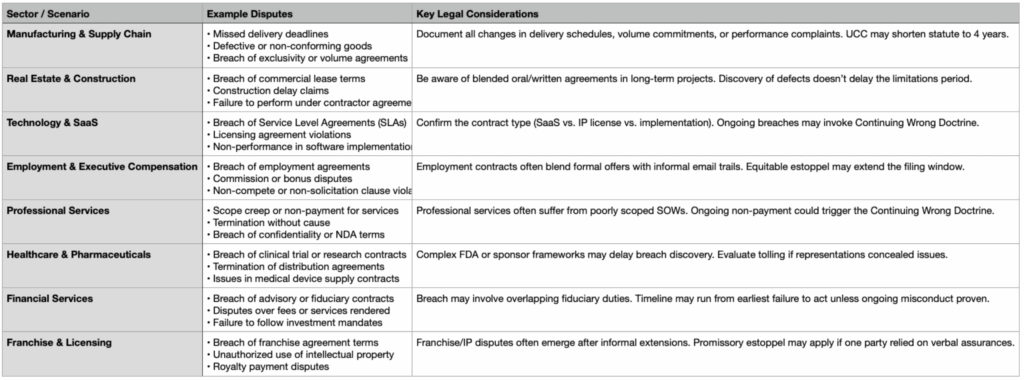
Yes. For example, supply chain disputes involving defective goods often fall under the UCC’s four-year rule. In contrast, breach of partnership or service agreements may be governed by CPLR’s six-year window. See our sector breakdown for examples.
Resources:
- Freedom Trust 2011-2 v. HSBC Bank USA, N.A.
- HOV Servs., Inc. v. ASG Techs. Group, Inc. (2024)
- CWCapital Cobalt VR Ltd. v. CWCapital Invs. LLC (2021)
- Henry v. Bank of America (2017)
- OTR Media Group, Inc. v. Vizible Media Group, LLC (2024)